All Banking Withholding Taxes — Rates & Sections
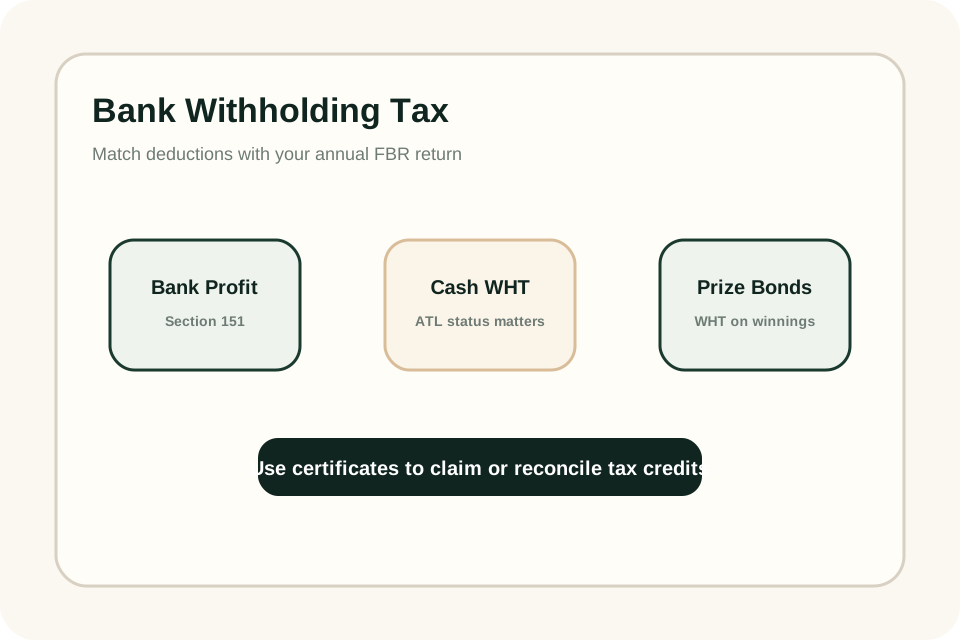
| Transaction | Section | Filer Rate | Non-Filer Rate | Threshold / Basis |
|---|---|---|---|---|
| Cash withdrawal from bank | 231AB | 0% | 0.8% | Withdrawals above Rs. 50,000/day |
| Profit on savings account / PLS / TDR | 151 | 20% | 40% | On all profit paid / credited |
| Prize bond winnings | 156 | 15% | 30% | On prize amount at encashment |
| Dividend from shares / mutual funds | 150 | 15% | 30% | On gross dividend paid |
| Mobile top-up / recharge | 236 | 15% | 15% | On all recharge amounts (no filer benefit) |
Why Banks Deduct Withholding Tax
Under the Income Tax Ordinance 2001, banks and financial institutions are designated withholding agents. This means they are legally required to collect income tax on behalf of FBR at the point of transaction — before crediting your account.
The WHT collected by banks is not a separate bank charge — it is income tax collected on FBR's behalf. The bank deposits it with FBR and issues you a certificate or statement of WHT deducted. Keep it to report the transaction under the correct advance, minimum, separate or final-tax category.
Section 231AB — Cash Withdrawal Tax
Section 231AB imposes withholding tax on cash withdrawals from bank accounts above a daily threshold. It applies to withdrawals from counters, ATMs, and any other cash disbursement method.
Section 231AB does not apply when the account holder appears on the ATL.
Applied when aggregate cash withdrawals exceed Rs. 50,000 in a day and the account holder does not appear on the ATL.
Daily cash withdrawal: Rs. 200,000
ATL account holder: Section 231AB does not apply
Non-ATL account holder: confirm the bank's Section 231AB deduction on the qualifying withdrawal
Read the full Cash Withdrawal Tax guide for the daily threshold mechanics, ATM vs counter rules, and worked examples.
Section 151 — Profit on Savings Accounts
Section 151 covers withholding tax on profit earned on any profit-and-loss sharing account, savings account, term deposit receipt (TDR), or other debt instrument from a bank or financial institution.
Deducted by the bank when profit is credited to your account — monthly, quarterly, or at maturity depending on account type.
Double the ATL rate. On Rs. 500,000 annual savings profit, a non-ATL person has Rs. 200,000 withheld versus Rs. 100,000 for an ATL person.
Do not treat Section 151 as universally adjustable. For covered individuals and AOPs with profit on debt up to Rs. 5 million, Section 7B imposes gross-basis tax and Section 8 makes that tax final. Profit above that limit, companies, special instruments and non-ATL excess withholding require classification under the current return.
Read the full Savings Account Tax guide for Zakat deduction interaction, Islamic banking accounts, and return declaration.
Section 156 — Prize Bond Withholding Tax
Section 156 requires the State Bank of Pakistan and prize bond encashment agents to deduct withholding tax on prize bond winnings at the time of payment.
Deducted at the time of prize encashment. Applied on the full prize amount — no threshold exemption.
On a Rs. 1,000,000 prize: an ATL winner receives Rs. 850,000 after withholding; a non-ATL winner receives Rs. 700,000.
Read the full Prize Bond Tax guide for denomination-specific prize tables, declaration in annual return, and how to encash prize bonds correctly.
Section 150 — Dividend Withholding Tax
Section 150 covers WHT on dividends paid by companies, mutual funds, and other entities distributing profits to shareholders.
| Dividend Type | Filer Rate | Non-Filer Rate |
|---|---|---|
| Company dividends (general) | 15% | 30% |
| Mutual fund dividend — equity-derived component | 15% | 30% |
| Mutual fund dividend — debt-derived component | 25% | 50% |
| Banking company dividends | 15% | 30% |
Dividend rates and treatment depend on the payer, fund income mix and recipient. Dividend tax is generally charged separately under Section 5 and treated as final under Section 8; do not automatically claim the deduction as ordinary adjustable advance tax.
Advance Tax vs Final Tax — What Banking WHT Is
Understanding whether a WHT is an advance tax or final tax determines whether you can recover it through your annual return:
| WHT Type | Nature | Creditable in Return? | Refundable? |
|---|---|---|---|
| Cash withdrawal (231AB) | Advance tax | Yes | Yes, if excess |
| Bank profit (151) | Depends on recipient, instrument, and section 7B treatment | Verify the return regime | Not automatically |
| Prize bond (156) | Final tax under section 169 | No ordinary advance-tax credit | Not as an ordinary adjustable credit |
| Dividend (150) | Separate/final-tax treatment generally applies, subject to the recipient and dividend category | Verify the category | Not automatically |
| Mobile load (236) | Advance tax | Yes | Yes, if excess |
How to Activate the Filer Rate at Your Bank
Banks apply WHT rates based on the filer status associated with your CNIC-linked account. The process to ensure you get the lower rate:
- Register on FBR IRIS and file your return. Visit iris.fbr.gov.pk, register with your CNIC, and file the complete, accurate return required for the relevant tax year.
- Verify ATL status. Visit atl.fbr.gov.pk and confirm your CNIC shows as an active filer. FBR's current ATL framework updates daily, although bank systems may reflect changes later.
- Visit your bank branch. Bring your CNIC, ATL printout, and NTN certificate (downloaded from IRIS). Request the branch update your account records to reflect your filer status.
- Submit a self-declaration if required. Some banks require a signed filer status declaration form — available at the branch.
- Confirm the update was applied. Check your next transaction statement to verify the lower WHT rate was applied.
Declaring Banking WHT in Your Annual Return
Banking deductions should be reconciled in the annual return according to the legal treatment of each section:
- Obtain annual bank statements showing total WHT deducted for the tax year.
- Log in to FBR IRIS and open your annual return.
- Report gross bank profit and reconcile Section 151 WHT using the fields applicable to Sections 7B, 8 and 151.
- Declare eligible cash-withdrawal WHT under the current Section 231AB advance-tax field.
- Report prize-bond winnings and Section 156 deduction in the applicable final-tax fields.
- Report dividends under the category applicable to the payer and fund income mix.
- Only deductions legally treated as adjustable can be netted against ordinary liability or support a refund claim.
Common Banking Tax Mistakes in Pakistan
- Not informing the bank of NTN/filer status — bank applies non-filer rates by default.
- Assuming every WHT deduction is refundable instead of checking the governing section.
- Assuming mobile load tax is affected by filer status — Section 236 applies at 15% to everyone equally.
- Not collecting annual WHT certificates — needed to reconcile gross income and deductions.
- Declaring only net profit instead of reconciling gross profit and Section 151 WHT under the correct regime.
- Not updating bank records after getting on the ATL — bank continues applying non-filer rates.
Related Banking Tax Guides
Useful Tax Tools & Guides
Estimate income tax alongside banking WHT.
Tax SlabsFBR Tax Slabs 2026-27Ordinary income rates where a separate or final regime does not apply.
NTNApply NTN OnlineRegister free to activate lower banking WHT rates.
VerifyNTN VerificationCheck ATL status to confirm filer rates are active.
FilingHow to File ReturnReconcile banking income and deductions correctly.
PropertyProperty Tax PakistanFiler rates also apply to property transactions.
Official FBR Resources
Frequently Asked Questions
What is withholding tax on bank transactions in Pakistan?
Banks deduct WHT on cash withdrawals above Rs. 50,000/day (Section 231AB), savings account profit (Section 151), prize bond winnings (Section 156), and dividends (Section 150). ATL status can materially reduce the applicable deductions.
How do I get my bank to apply the filer (lower) WHT rate?
Register on FBR IRIS, file the required accurate return, verify ATL status at atl.fbr.gov.pk, then visit your bank branch with your CNIC and ATL printout. Request they update your account records to reflect filer status.
Is banking WHT a final tax or advance tax?
Treatment differs. Cash-withdrawal and mobile deductions may be advance tax; prize-bond winnings are final tax; dividends generally follow separate/final treatment; and bank profit depends on Sections 7B, 8 and 151 plus the recipient, instrument and amount.
Can non-filers recover banking WHT?
Filing is required to reconcile any legally adjustable deduction, but filing does not convert final or minimum tax into an ordinary refundable credit. Confirm the section and return category first.
Which banking transactions are exempt from WHT?
Cash withdrawals below Rs. 50,000/day are exempt from Section 231AB. Online transfers (IBFT) are generally not subject to cash withdrawal WHT. Verify current exemptions at fbr.gov.pk.
Summary
Banks in Pakistan deduct withholding tax on cash withdrawals, savings profit, prize bonds, dividends, and other transactions. For most of these, ATL status often halves the withholding rate. The legal treatment is section-specific: some deductions are advance tax, while others are minimum, separate or final tax.
Register on FBR IRIS, file the required accurate return, inform your bank of your filer status, retain every certificate, and report each item in its correct return category. Do not claim adjustment or refund merely because tax was withheld.